01Available today
Understand the workforce
What can this organization actually do today?
- Reads
- Roles, goals, assessments and the work already on record
- Writes
- A capability map, and the gaps that earn a plan
ORAVON COMPANY
One record runs under all four decisions — who to develop, who to hire, how work is reviewed, and what you can commit to. Each area reads what the last one wrote.
Workforce, Hiring, Performance and Delivery available today · free sandbox, no card
THE PROBLEM
Who to develop, who to hire, how someone is reviewed, whether a commitment can be met — each is decided somewhere else, on different facts. When one of them is reopened, the reason has to be rebuilt from memory.
Four systems, four versions of the truth
Development plans in one system, interview notes in another, reviews in a third, committed work in a fourth — none of them agree, and none of them kept the reason.
The evidence never crosses the handoff
What the interview showed does not reach the manager. What the review showed does not reach the next hiring decision. Every stage starts from zero.
You will be asked to justify this a year from now
Usually by someone who was not in the room, about a decision whose supporting evidence has since been migrated, archived, or forgotten.
THE SOLUTION
One evidence record runs underneath workforce, hiring, performance and delivery. Each area reads what the last one wrote, and every decision a person confirms is written back with the evidence it stood on.
ONE SYSTEM
This is what separates ORAVON Company from an HRIS, an applicant tracker and a project tool: each of those owns a stage and hands the next one a summary. Here the stages share the record itself.
What can this organization actually do today?
Which candidate closes the gap, and can we defend the choice?
How did the work actually go, and what changes next?
Is the commitment deliverable at the capacity we have?
WHAT TRAVELS BETWEEN THEM
Evidence
The assessment, the interview, the indicator — the artefact itself, not a summary of it.
Context
Which role, which goal, which team and which period the evidence belongs to.
Human-confirmed decisions
A person decides and confirms; the record keeps what they decided on.
Continuity
The next stage opens on what the last one wrote, not on a blank form.
Accountability
A year later the record still answers who decided, on what, and why.
All four areas run this way today, on the same record. Talent Discovery belongs to the same system, is not available today, and carries no price.
CAPABILITIES
Workforce, Hiring, Performance and Delivery Intelligence are available today on one shared evidence record. Talent Discovery is named here because it belongs to the same system — it is not available today, and it carries no price.
For the leader who must grow the team they have
Map what the organization can actually do: capability against role and goal, the gaps that matter, and a development plan with tracked progress. The gaps it names are what hiring and performance read next — development as a system, never a surveillance score.
Decision enabled: Which gap earns a development plan, and what the plan delivered
For the leader who must defend the offer, not only make it
Hire against a named gap rather than a job description written from memory: structured screening and interviews, real performance evidence behind every evaluation, and the reasoning kept with the decision. Your team decides, better informed and in less time.
Decision enabled: Which candidate earns the offer, and why — on evidence, not impression
For the leader who owes people a fair, documented review
People and team KPIs, review cycles and the improvement loop, opened on what the person was hired for and the plan they started on. Organization-goal depth is planned and not available yet.
Decision enabled: How performance actually went, and which improvement loop follows
For the leader who must match committed work to real capacity
Set committed work against the capacity you can evidence. An undertaking reads the same record — capability, people, performance — and reports coverage on every requirement: who meets it, who has never been assessed, and where one person is the only holder. What was never measured is shown as unknown, not as a gap.
Decision enabled: Whether the commitment is deliverable at the capacity you have
For the leader who will need talent beyond their own walls
Planned future scope; not available today. The plan is to connect need definition, talent discovery, matching, and evidence reports to a decision that stays with the company.
Decision enabled: Which external talent matches the need, on what evidence
PRODUCT PROOF
From a development need to a hiring decision, then the performance loop, then the delivery question: can we commit to this at all? These are the product surfaces, not generic admin illustrations.
Deterministic, non-production demonstration data. No real employee, candidate, customer, score, ranking or outcome is represented — and every capture carries the same disclosure inside the frame.
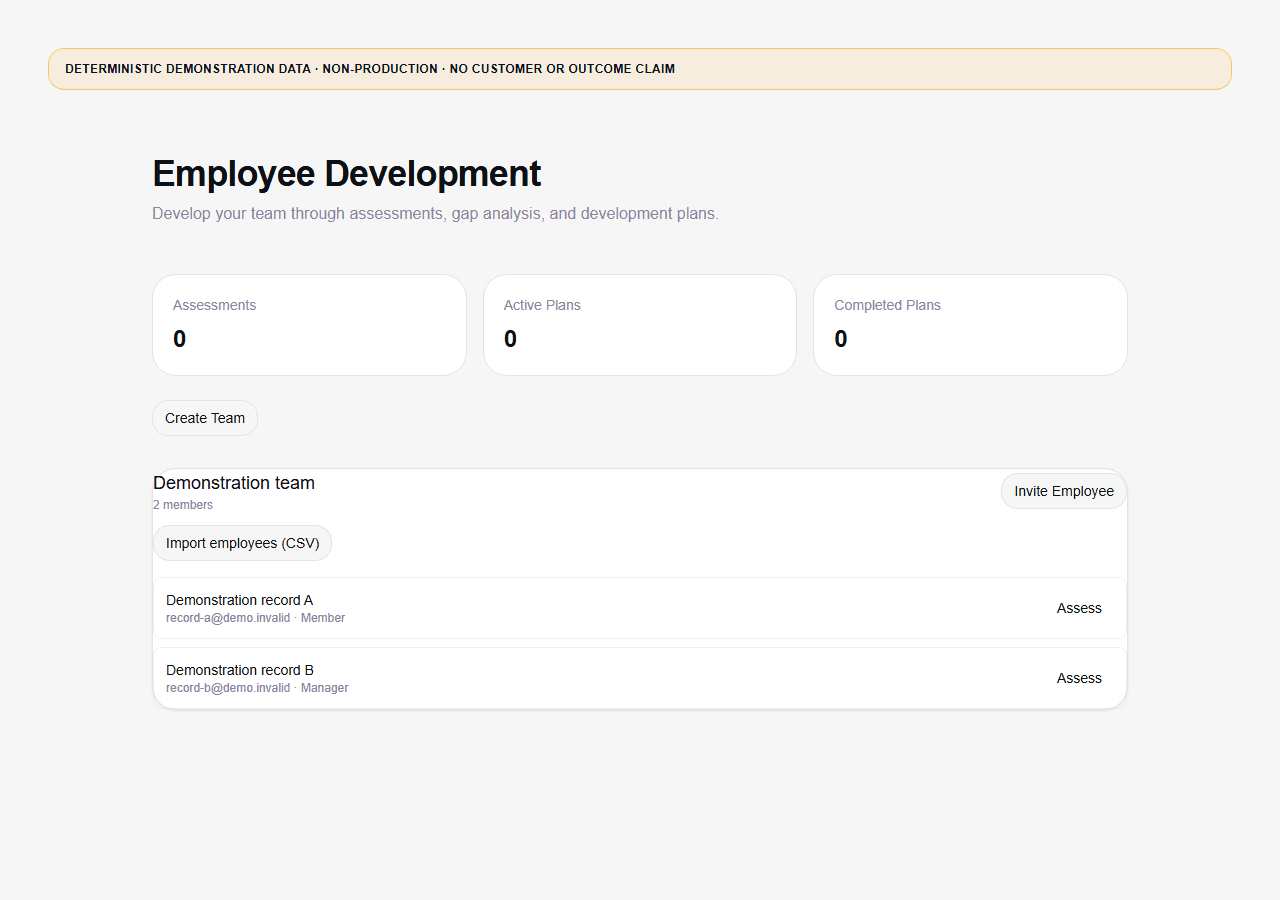
What the organization arrives with
A real team, and the usual substitute for knowing it: a skills spreadsheet somebody typed from memory.
What ORAVON does
The assessment state of every person on the record is read, and the three counts are reported separately — assessments, active plans, completed plans — instead of being blended into one readiness number.
What the screen shows
Employee Development: the team, each member's role, and an Assess action per person. This demonstration organization has run nothing yet, so all three counts read zero and the screen says so plainly.
What the decision-maker does next
Assess a named person, or import the population first. Nothing is recommended on evidence that was never gathered.
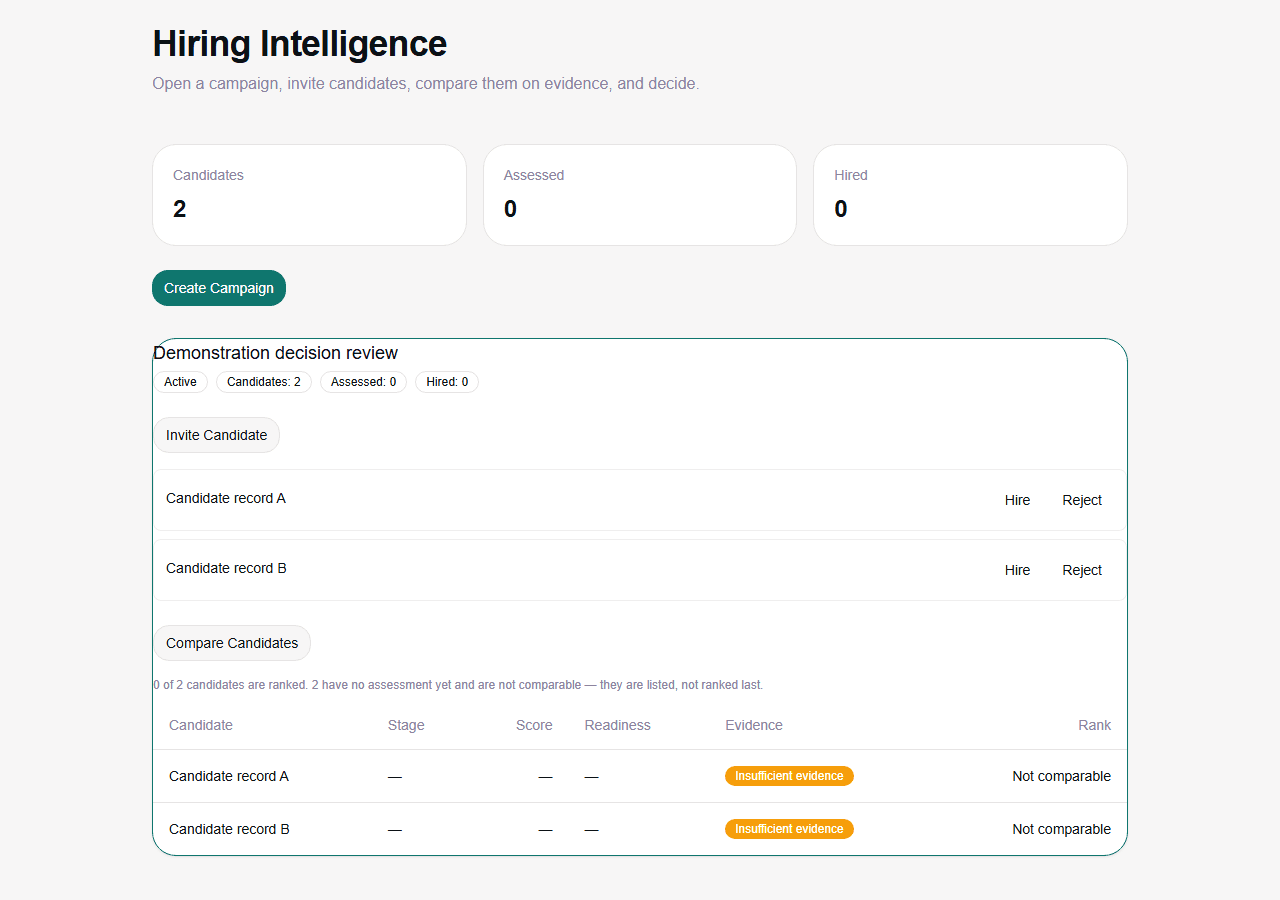
What the organization arrives with
Two candidates in one campaign, and no assessment on either of them.
What ORAVON does
The comparison still runs, and reports its own coverage: 0 of 2 ranked, 2 not comparable. ORAVON will not order people on evidence it does not hold.
What the screen shows
The comparison table with Stage, Score and Readiness left as em-dashes, Evidence marked Insufficient evidence, and Rank reading Not comparable. The decisive sentence is on the screen: they are listed, not ranked last.
What the decision-maker does next
Assess them, or decide without a ranking and know that is what you are doing. Hire and Reject stay available; a fabricated order does not.
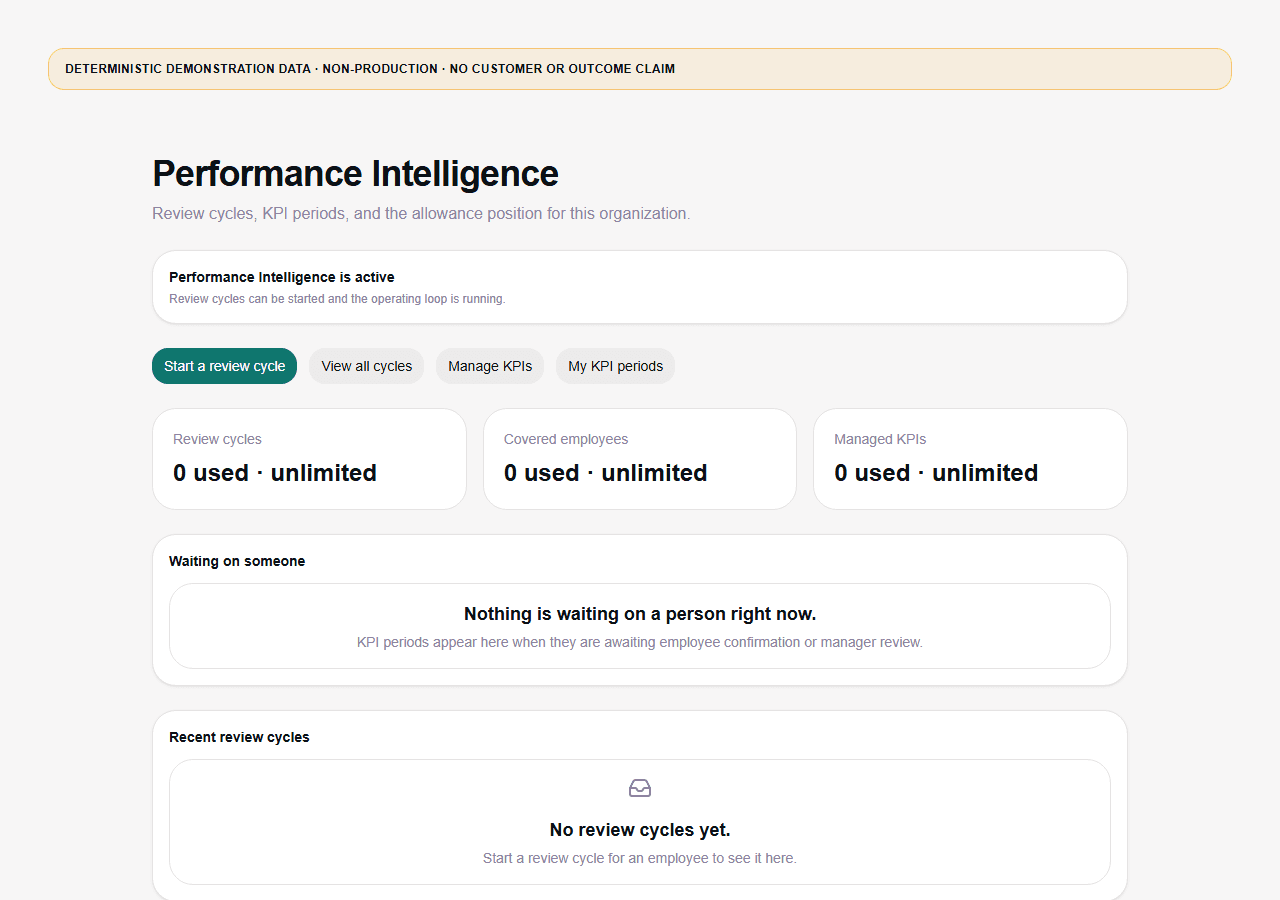
What the organization arrives with
A review cycle that has not started, and an allowance you need to understand before you commit to one.
What ORAVON does
The allowance position is computed and stated first — review cycles, covered employees and managed KPIs, each as used against limit — and what is waiting on a person is kept separate from the history.
What the screen shows
Performance Intelligence, active, with every allowance at 0 used and no review cycles yet. “Nothing is waiting on a person right now” is an explicit empty state, not a blank panel.
What the decision-maker does next
Start a review cycle, define KPIs, or confirm the allowance covers the population you intend. This frame proves the loop exists and is entitled; it does not show a finished review.
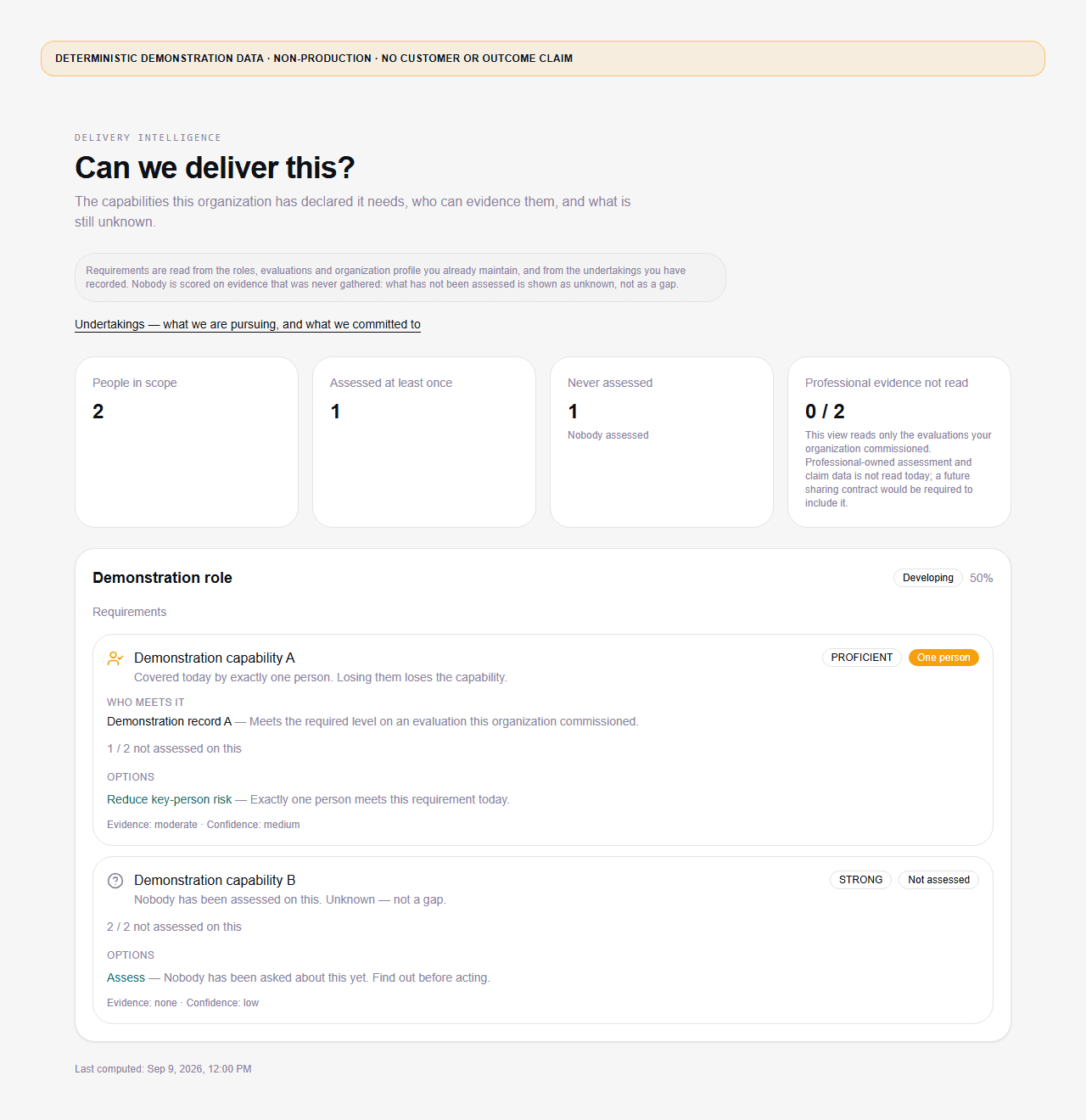
What the organization arrives with
An undertaking the organization is weighing, the capability requirements it already maintains on its roles, evaluations and profile, and two people: one assessed, one never assessed.
What ORAVON does
The same Opportunity Readiness engine, lifted from one-person-against-one-opportunity up to a workforce against a commitment. “Never assessed” is kept a separate status from “not covered”, because the first means ask and the second means hire.
What the screen shows
The question as the heading — Can we deliver this? — then coverage on every requirement: one marked One person, naming who meets it and offering Reduce key-person risk; one marked Not assessed, reading “Unknown — not a gap”, offering Assess. People in scope, assessed and never assessed are counted above, and evidence strength and confidence are printed under each requirement.
What the decision-maker does next
Assess before acting, or reduce the single-holder risk — before the commitment is made rather than after it slips.
OUTCOMES
PRICING
Buy Workforce, Hiring or Performance on its own, or run them on one record with Company Complete. Delivery runs alongside them on the same record.
Develop the workforce you have.
Core
For teams starting structured development
$299 /month
$2,990/year
Scale
For organizations running development at scale
$799 /month
$7,990/year
Hire with evidence, in less time.
Core
For organizations making periodic hiring decisions
$449 /month
$4,490/year
Scale
For organizations hiring continuously
$1,099 /month
$10,990/year
KPIs in organizational context.
Core
For teams starting documented review cycles
$349 /month
$3,490/year
Scale
For organizations with wider performance cycles
$899 /month
$8,990/year
Commit to dates you can evidence.
Core
For teams committing to dated delivery outcomes
$699 /month
$6,990/year
Scale
For organizations running parallel undertakings across teams
$1,699 /month
$16,990/year
The Company capabilities on one evidence record — for less than buying them separately.
Company Complete is priced when its public price is approved.
Core
Talk to us /month
Scale
Talk to us /month
Explore free
A limited sandbox workspace with demonstration data. No card required.
Enterprise
Custom scope, regional and compliance requirements, dedicated onboarding.
Talent Discovery is a planned future capability — not available today, and not for sale.
Launch pricing shown. Annual billing equals ten months — approximately two months free. Workforce Intelligence, Hiring Intelligence, Performance Intelligence and Delivery Intelligence are available today; no purchase action is offered for a capability that is not available.
FAQ
Start with one area today — Workforce, Hiring, Performance or Delivery — or bring them onto one record with Company Complete.